Showing posts with label guides. Show all posts

Wednesday, July 16, 2014

Hulhumalé, Maldives: A Newborn Artificial Island

Our low-cost airline flight provided an on-board entertainment that surpassed all others we've experienced... The spectacle of Maldives' islands, strung together like a jewel necklace, sitting oh so pretty in the middle-ish of Indian Ocean nowhere. It was one of those travel moments filled with imaginative swear words, muttered under the breath.
hulhumale1
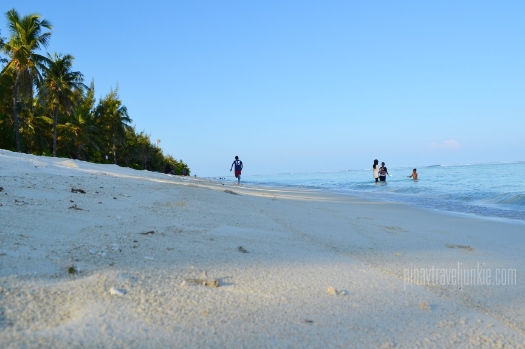
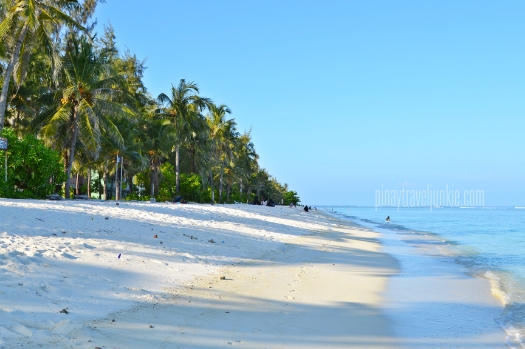
Hulhumalé's public beach. Frequented by Maldivians. 

The Republic of Maldives never made it to our bucket list prior the trip, because back then it was our choice not to afford it. Hubby and I keep our respective lists quite realistic. And Maldives is one of them countries we thought we'll only consider visiting when we're old and gray and subject to carbon dating.

We felt our few savings was better spent somewhere else.

hulhumale2
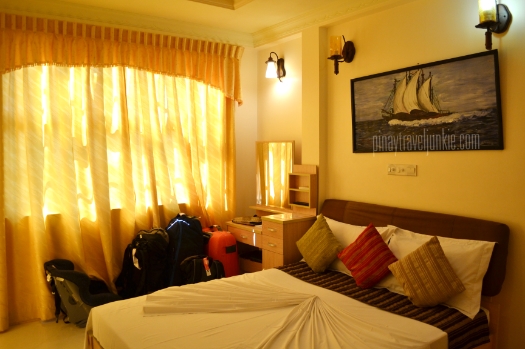
Hulhumalé Inn, our accommodation on the island.

But we chanced upon an airline company website glitch last year — thanks to a tip that circulated within the travel blogging community which allowed us to book a cheap flight from Sydney to Kuala Lumpur to Malé for three. The total price, about $4. We took that as a sign. Cause really, we'd be stupid not to grab such rare opportunity. So we purchased tickets. Without worries whether we could fund the unplanned luxe getaway or not.
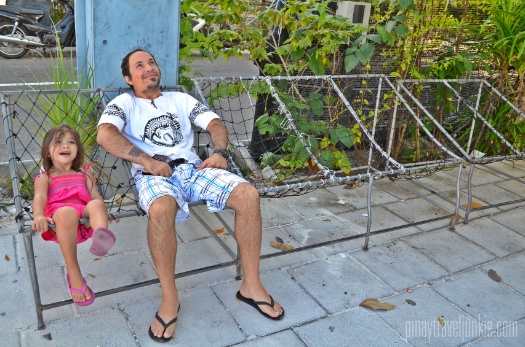
hulhumale3
A Maldivian 'bench'. Dunno what they're looking at.
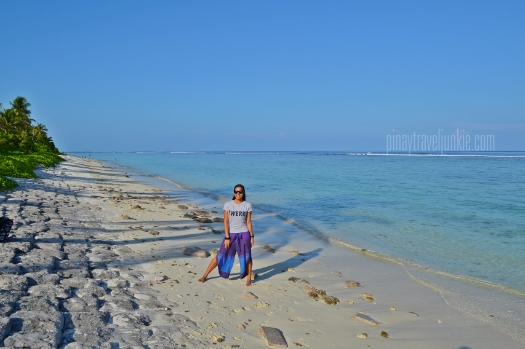
 
And two months later, there we were celebrating our fifth year of togetherness with our toddler Luna, thousands of feet above the ground.The flight itself exceeded our expectations. Ibrahim Nasir International Airport, or simply Malé International Airport, ain't much of a looker. But outside its arrival hall where the port for ferries to the capital and private resorts' speed boats is, one can have a quick taste of paradise. The water is a gorgeous aquamarine.

hulhumale4
A more conservative approach to clothing on this inhabited island.
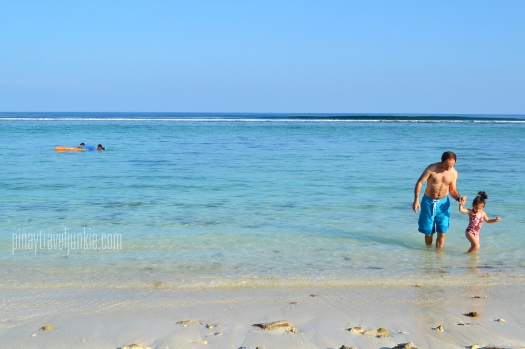
Queues at the immigration counters were long, took a while before our turn. And when it was, the officer simply stamped our passports. No questions asked. We grabbed our luggage and sped towards the arrivals. We arranged our pickup ($15 for all of us) through Hulhumalé Inn, a ten-room guesthouse on Hulhumalé Island, wherein we were booked for the night. We would have taken the public bus, but each passenger was only allowed a luggage each. After shopping in Australia, we had tons.
Public Bus Service On Hulhumalé Island 
A bus service runs between Malé International Airport and Hulhumalé island between 6:00AM to 2:00AM, operated by Maldives Transport and Contracting Company. It leaves Nirolhu Magu's (neighborhood 1) bus stop roughly every forty minutes to one hour and is a mere 15 minute-ride. Station at the airport should just be outside the arrival hall. Ask around. In the evening, bus may run every two hours. Each passenger's allowed only a luggage each at the time of our travel (2013). Fare is MVR3 or about US$.20.
hulhumale5
Man-made beauty, this reclaimed island.

Driver helped us dump all our stuff in the van (Maldivians know so well how to give good service, in such regard, keep a stash of small bills to give away as tips). Our party of three was whisked to the guesthouse, not stopping for anything even when some locals signaled to hitch a ride. Upon arrival, we were handed welcome drinks. The staff brought our luggage up the room while we quickly filled out the check in forms. We couldn't wait to explore the hood.
Hulhumalé Inn Review
It did its job well in giving us a comfy pod to sleep in. Our simple double room priced at UD$70 excluding taxes and fees (Yep, welcome to the Maldives!) has an en suite bath and a small balcony. It faces the main street which never gets too hectic. WiFi was a pain, hair-pulling slow during the few times we were able to connect. A simple brekkie is included in the room rates. Egg and toast and cereal. Coffee and tea. Kitchen opens at 6:30-7:00AM. There are cafes nearby, and the beach is just a couple of blocks to the east. The guesthouse offers package tours. Staff was as warm as the Maldivian sun's rays.
hulhumale6
Beach got busy as the day approached sundown.

Hulhumalé's role to us was not limited to being a transit stop. It served as an educator. It gave us a brief introduction to Maldivian culture. 

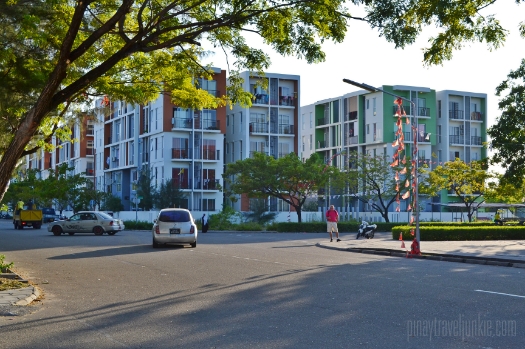
The island was constructed (completed in 2002) on a shallow lagoon in the same atoll as the capital's, and is linked to the island of Hulhulé. Its purpose is to address the country's growing population density. On our stroll around the neighborhood that afternoon, we passed by blocks and blocks of newly built (and under construction) residential buildings. Structures are mostly four to five stories high. Not all were occupied. Perhaps exodus has not commenced yet.

hulhumale7
New flats. Cheaper rent compared to Malé's.
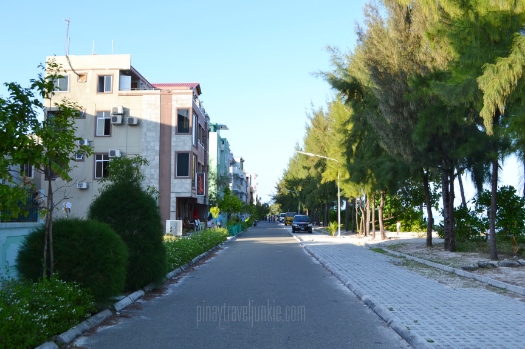
 
From the relatively busy Nirolhu Magu street, we walked two blocks to get to the shore. At the public beach, we let our feet sink into the white, powdery sand. I could not believe we were basking in artificial paradise. 

Hubby and Luna waded in the water while I watched a group of local women, all covered up, lie on/roll over the sand and chitchat and giggle like young girls. Islam is the official religion of Maldives. On inhabited islands, female tourists are expected to maintain a conservative approach to clothing. The thought of swimming in pants and shirt put me off (though I knew about this beforehand) since I didn't see any public changing rooms nearby. I'd have to saunter back to our guesthouse dripping. I don't know what's more unacceptable: Being in the water wearing a swimsuit, or being out on the street looking like a wet t-shirt contest participant. Nah to both.

hulhumale8
  Access to public beach. Not a lot of seaside cafes here. Alcohol is only sold/may only be consumed in Hulhulé Island Hotel.
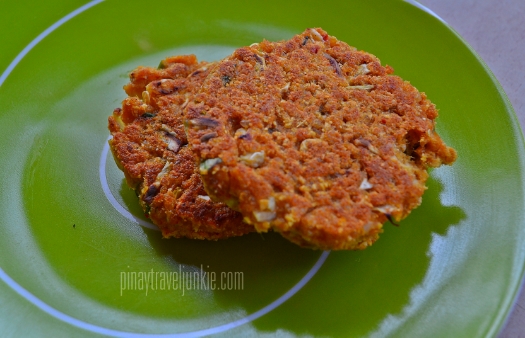
 
Before heading back to Hulhumalé Inn, we searched for a place to eat because the guesthouse doesn't sell food. There were only a handful of convenience stores and sai hotaa (tea shop) on the island during our visit. Like in India and Sri Lanka, the cafes are mostly populated by men. I was the only female at Cafe De when we dined. We ordered a fishcake which tasted more like a hot pepper cake, sweet sticky rice (apparently to balance out the spiciness of the pepper patty – I mean, fishcake), and hamburger (a safe order for Luna).

guide6
Fishcake. Or so we were told.

A cafe's a great place to start interacting with locals. In our case however, we weren't thrown random questions. We only received a lot of stares. I initially thought, perhaps because I'm female. But then the Maldivians, to me, didn't seem overly conservative. 

Maybe Hulhumalé's residents are simply not used to curious travelers. Not like the thousands deployed in other islands who were trained to entertain. Or maybe this newborn community a melting pot of sorts is still in the process of welding its cliques within. And still in the process of establishing their set of norms which has not tackled the subject of striking up conversations with foreigners. Or for all I know, we just didn't stumble upon a local who's intrigued enough.

The island of Hulhumalé, the newest kid on the block ( or make that, the newest island in the atoll), may be artificial, but it gives visitors a peek at real Maldivian life. Something you won't witness in a high end resort. Something worth experiencing even for a short while.


Missed our guide to backpacking Maldives? Click HERE.

Share

This page was viewed times.
Tuesday, May 27, 2014

Lemuhen Cultural Dance Troupe Inc. And The Dance Born From A Dream

They wore the shyest of smiles. Their welcome, so warm and affable that it felt like coming home to long lost relatives. But they're total strangers to us. The residents of Baranggay Badtasan in Kiamba, Sarangani Province had been waiting all early morning for our entourage composed of SOCCSKSARGEN and Luzon-based bloggers.

The air was dense with jovial anticipation.

lemuhen1
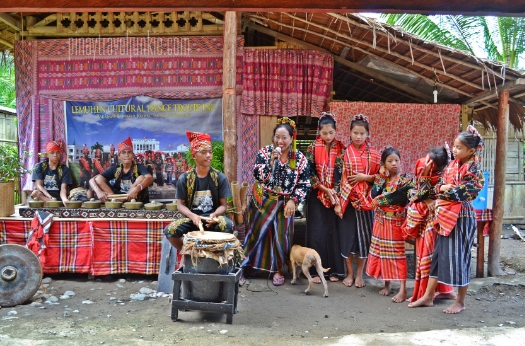
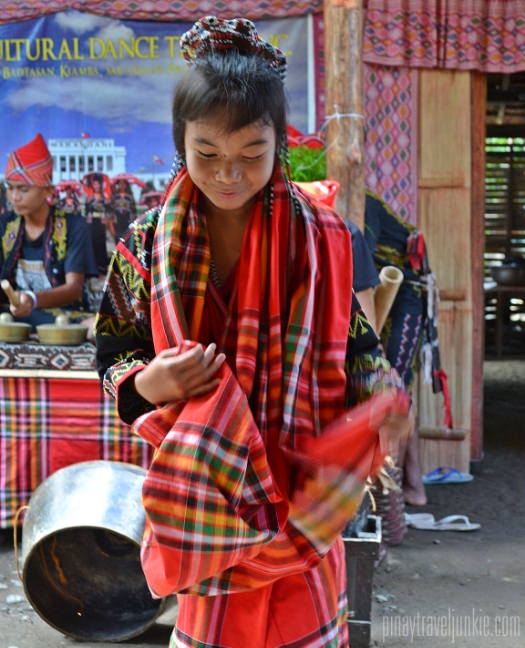
The Lemuhen Cultural Dance Troupe Inc. about to perform T'boli dances. The T'boli are one of the indigenous peoples of South Cotabato.

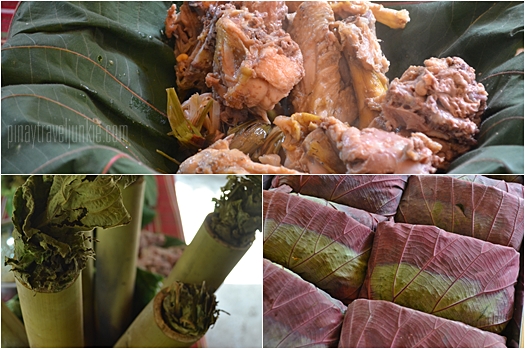
Under a hut modeled afer a traditional T'boli house, a long table was prettily ornamented with bright red, plaid tablecloth. The sleepless and famished (and hungover) I was drawn towards the elements on the table: Boiled plantain, boiled sweet potato and kamoteng ube (purple yam), sumang (rice cake cooked in palm or banana leaves) kamoteng kahoy (cassava), steamed rice wrapped in leaves, and nelut onuk which is native chicken stewed in a bamboo stalk over a fire pit for two hours. Pancit bihon guisado (Filipino noodle dish) was the odd one out only cause it's the most familiar to the Manila-raised traveler, me.

lemuhen2
Top: Nelut Onuk, native chicken stewed in bamboo for two hours. Bottom Left: Bamboo where the chicken was cooked. Bottom right: Rice wrapped in leaves. 
 
A short prayer led by Lyn Lambago, founder of Lemuhen Cultural Dance Troupe Inc., commenced the simple feast. Lyn also gave us a brief introduction to traditional T'boli food before we all dug in. The T'boli fare is simple yet tasty, and made with ingredients that can be harvested off their land.

I had a bite of almost everything. The native chicken, no doubt, was the celebrity of the spread. The crowd favorite. We loved it so much that some of us fenced using our forks for the last few pieces.

lemuhen3
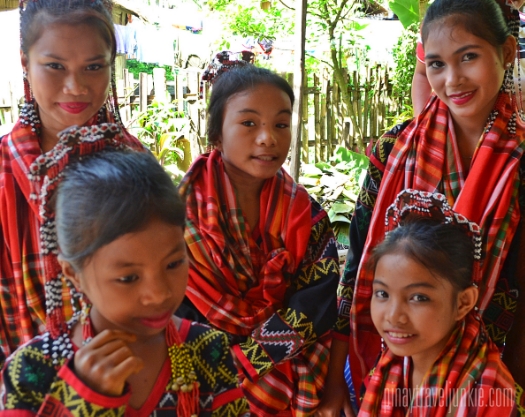
A bashful performance. Reflects how gentle the T'boli people are.
 
Breakfast wasn't the main event though. It was simply a prelude to a T'boli dance performed by the Lemuhen Cultural Dance Troupe. The dancers, all young — no more than mid-teen, were taught by the founder Lyn herself. She who established the dance troupe whose main objective is to preserve traditional dance. A side quest of Lyn's is to help the youngsters with their education. In fact, sponsors are welcome to donate cash to fund their school supplies.

lemuhen5
Timid. Cute. 
 
We were shown snippets of various T'boli dances by the young ones such as: Madal semgewet (courtship dance), madal soyow (warrior dance) and madal betaku (witch dance). The real treat was the dance that Lyn learned from a dream which she performed herself. She calls it madal tahu. A years-in-the-making choreography that requires one to dance mostly on tiptoes. Lyn, who's on the heavy side, pointed out how difficult it is for her to perform it these days. But according to her, because of spiritual guidance, she manages to do it.

lemuhen6
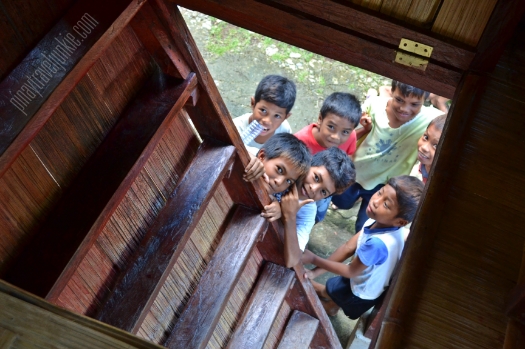
The kids of Baranggay Badtasan cheekily peek from downstairs of the T'boli house.

After the performances, we were ushered upstairs the T'Boli house. Its interior walls are adorned with traditional T'boli clothes. In one corner, hung a blown-up photo of the troupe printed on a tarpaulin. Lyn beamed with pride as she related the story of how this project came into realization. And she thanked Sarangani Governor Steve Solon's better half Michelle Lopez-Solon for her tireless assistance. 

It was actually Ma'm Michelle who invited us bloggers to come over and experience the adventures that Sarangani offers.

lemuhen8
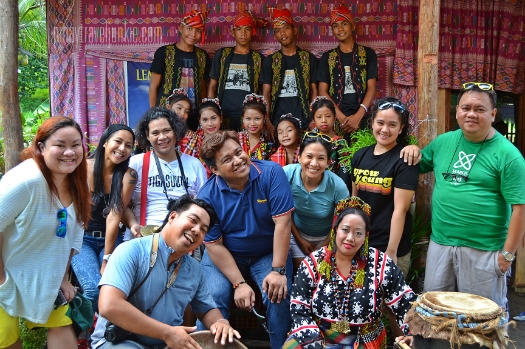
Lemuhen Cultural Dance Troupe Inc. with SOCCSKSARGEN and Luzon-based bloggers and Ma'm Michelle Lopez-Solon.
 
And Baranggay Badtasan was a great place to start. The morning event was a preamble to the Sarangani familiarization trip that tapped all five senses. We couldn't wait to see, hear, smell, taste, and touch more (especially the, uhm, touch part — wait for the future posts!).


Visiting Sarangani? Go Sarangani Travel can help you organize your trip. Visit their web page https://www.facebook.com/gosaranganitravel and send them your inquiry.


Share

This page was viewed times.
Tuesday, May 6, 2014

2Go Travel: Batangas-Boracay (Via Caticlan) Route

Late afternoon on a Sunday, mid-March, Batangas Port Terminal 2 looked glum and abandoned from the outside. Our van circled the lonely two-story structure until we got to its main entrance. Summer was just about to start in the Philippines, and the crew of GMA News TV's Pop Talk were off to an early sun worship. That, and a shoot in Boracay for their third anniversary special episode.

I was to be a guest on the show. And truth be told, that's the only reason why I was going back to the island. I'm not a big fan of what the place has become, so I certainly wasn't thrilled to learn (The night before the trip!) that we'll be traveling for nine hours by vessel to get there.

"The journey is the destination." These words rung in my ears. I had been cooped in a cozy shell too long, I turned into a whiner. I opted to suck it up. To, you know, practice what I preach.

2go1
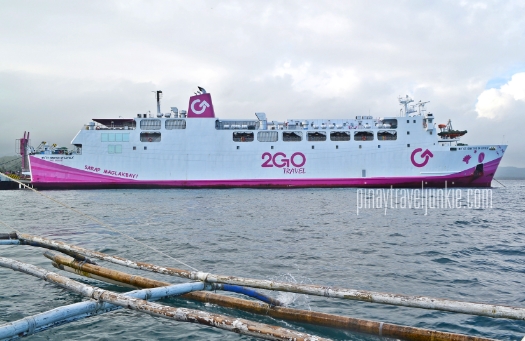
A behemoth. With a cute color scheme.

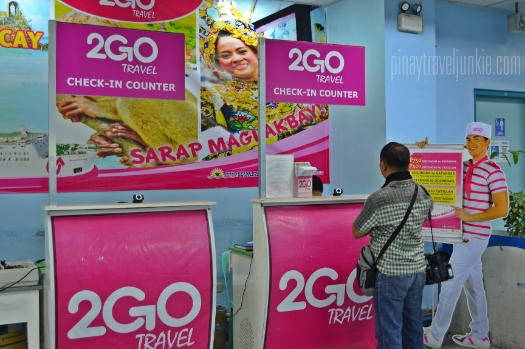
We hopped off the vehicle as soon as the other van arrived, and followed the lead of 2Go Marketing and Events Manager Ervin Andaya. Our group was there two hours before boarding time so we didn't battle our way in. The cameramen took their time placing their precious equipment on the conveyor belt for the x-ray machine while the rest of us proceeded to the check-in counter.

One by one, our photos were taken with a webcam for documentation. Tickets were distributed and we all dispersed.

2go2
 Pop Talk cameraman Kuya Obet, checking in and having his photo taken for documentation.

Batangas Port Terminal 2 ain't flashy, but well kept. It's air-conditioned, and could get darn cold when uncrowded. There's a 7-11, a cafeteria, even a massage stall. Smokers may go out for a drag, just ask the guard where. The place did a pretty job in entertaining us those two hours. And because I was in good company, I hardly noticed the time.

2go3
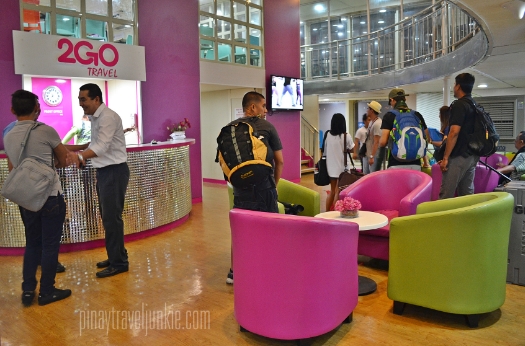
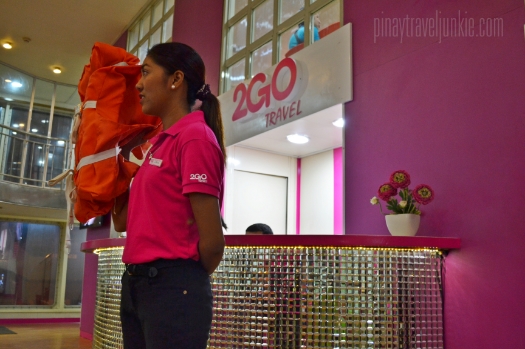
 The reception.

We were allowed to board half an hour earlier so that the crew can do a quick shoot. Before setting foot on the vessel, luggage are further inspected by a sniffer dog. May take only a few seconds per person but could cause a build up on human traffic.

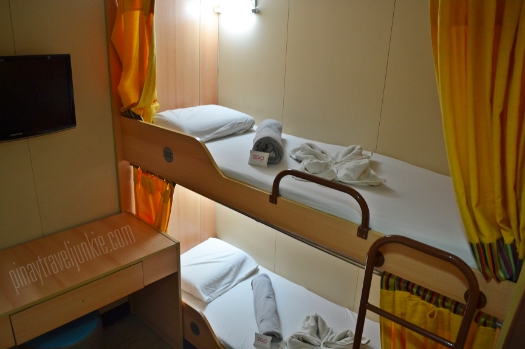
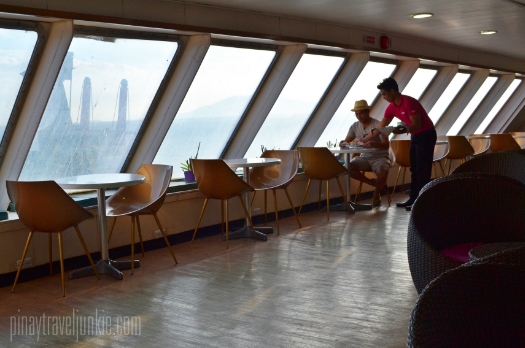
Up the steps, on the first landing, is the reception/lobby and a snack bar. The cabin and state rooms, in which we were assigned, are on this level as well. I checked in a cabin good for four, and shared it with Ervin who quickly became my bestie in the group.

2go4
Cabin good for four, shared by only two.

2go8
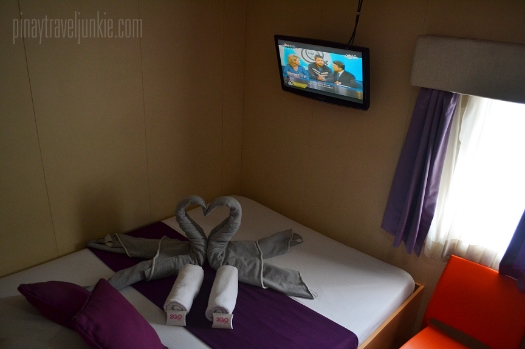
State room. Upgraded to this on the ride back. Each cabin/state room has a flat screen telly and an en suite bathroom with hot and cold shower.

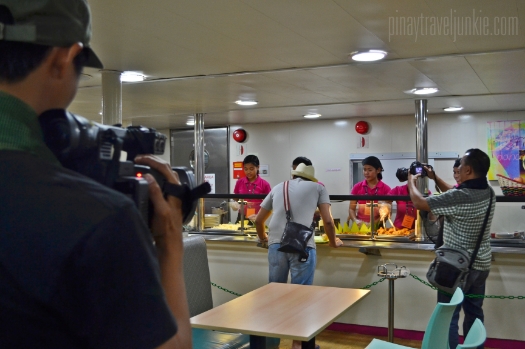
Keen on hitting the sack early, we headed to Horizon for dinner before the rest of the passengers started pouring in. The restaurant's on the next level above the lobby, same floor as the Super Value Class hall. Horizon's meals are far from fancy, but still a good feed. Reasonably priced too. The group ordered every kind of dish available. We finished our feast well before the 9:00 PM departure time.

2go5
Pop Talk's host, Kuya Tonipet, chooses a meal at 2Go's resto Horizon.

2go7
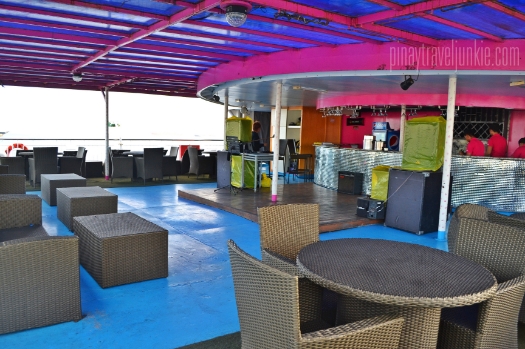
The lounge.

Once all the passengers were settled in, a safety demo was conducted by the crew (was also shown on telly screens at the lobby and in Horizon). During which time, we heard the engine rumble to life. We finally began our journey to the island of Boracay.

2go6
Pre-departure safety demo.

My roommate and I decided to take a peek at the bar before calling it a night. We found the whole Pop Talk crew there and they sure weren't ready to retire. A tower of weng weng was sitting on their table and yes, we joined in the fun. We watched the cover band, requested for songs — even danced to a couple of 'em.

I sang the last song (I drunkenly volunteered to do Shakira). Everyone was on their feet at that point. Dancing, or leaving the bar cause of my singing, I wasn't sure. I didn't care. 

2go9
The bar at daytime.

The band bade goodnight. We bade each other goodnight too. But instead of going back to our respective rooms, celebrity Mico Aytona and I stayed behind to chug all unfinished drinks and babble about random stuff. He and I were up until four-ish in the morning and the vessel was to arrive at Caticlan Jetty Port in less than two hours.

Nine-hour journey. Just like that.

"The journey is the destination."  

2Go Travel knows so.

2go10
Definitely doing this again.

For more information and for bookings, visit:
http://travel.2go.com.ph

Schedule of trips here: http://travel.2go.com.ph/Schedules/schedules.asp

Batangas-Boracay tickets prices (as of writing):

Super Value Class - 1,163.99 pesos inclusive of taxes and fees (about $26)
Tourist Class - 1,264 pesos inclusive of taxes and fees (about $28.50)
Cabin for 6 - 1,465.40 pesos inclusive of taxes and fees (about $33)

eTicket Itinerary Receipt

eTicket Itinerary Receipt is non-transferable. It is valid within one (1) year from the original date of issuance. In case wherein the passenger was not able to board their ticket, the ticket may still be refunded or revalidated within its validity date subject to surcharges and that it is not under the NON-REFUNDABLE promotion.

Traveling With Children

Children two (2) years old and below and children one (1) meter and below in height are considered infants. A fixed rate of Php205.00 plus 12% VAT will be charged per infant regardless of destination or accommodation. All surcharges are waived.

A separate ticket will be issued for the infant, however, he/she will be sharing his/her parent or guardian's bunk or room.

No more than two (2) infants will be allowed per adult passenger. The succeeding infants will be charged full promo fare or 75% off on base rates plus all the surcharges.

Infants will not be boarded unless accompanied by an adult (parent or guardian).

IMPORTANT: Read the Terms And Conditions before entering credit card/ATM card details.

Share

This page was viewed times.
Monday, March 24, 2014

Withlocals.com: Going Local With Locals

Immerse. Have we not heard this countless times from seasoned travelers? And have we not thought of this as — now let's be honest here — a gargantuan task to fulfill? 

When on the road, going local is how I usually roll. Many years of backpacking taught me how to trust in the good of humanity, in good karma and in the positive vibes of the universe. This idiosyncrasy of mine, and of fellow nomads, may be difficult for holidaymakers to comprehend. Undecipherable even, for the wary. 

So how do we introduce this so-called "immersion" to occasional vacationers who lack time, extra dough and well, credence?
 
withlocals1
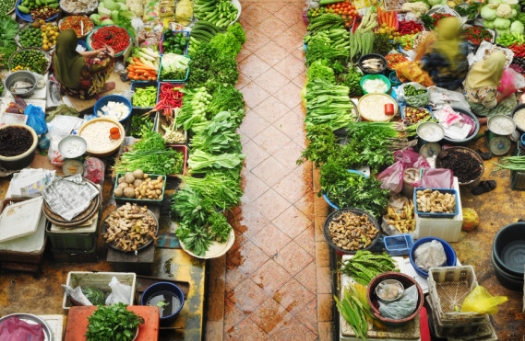
The Pasar (Market) Tour in Malaysia organized by local Khairun Halina.
 
Withlocals.com comes to our aid. 

TheWithLocals website is a "marketplace connecting travelers from every corner of the world with locals in Asia offering unique travel experiences and home dining opportunities...". It's an online platform that helps build personal relationships between travelers and locals, that could begin even when distant from each other, at the click of a mouse.

Locals sign up as hosts and offer services for reasonable rates, and travelers sign up to "book experiences". These experiences are sorted into three categories:  

withlocals3
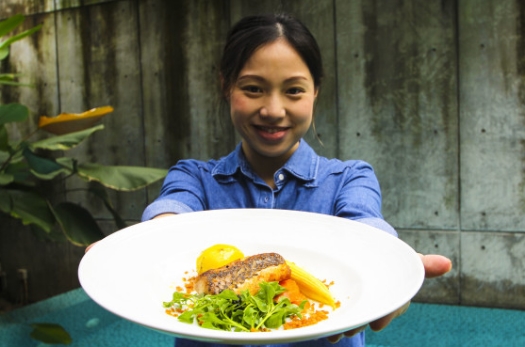
EAT Withlocals, wherein you get a real taste of the local culture by dining with a family in their home; 

withlocals4
TOURS Withlocals, wherein you get to discover off-the-beaten-track sites under the guidance of your host

withlocals5
and ACTIVITIES Withlocals wherein you don't just observe locals do their thang, you get to learn/do them yourself too!

"But it ain't for free!", I hear you say.

WithLocals.com believes that "every person is good at something and that there’s no greater way to earn a living than by doing something you are passionate about.". The site provides an opportunity for people, especially locals in developing countries, to boost their income by showcasing their skills and sharing their knowledge. You might have spent money on a travel agent before, and hey, this isn't really any different. Okay, except the middle-man's slashed. And isn't that a good thing?

Yes, the best things in life are free, but ain't it better if you're able to help out others?

withlocals2
Ultimate experience. You may find it here.
 
Head over to their website and learn more about, quite possibly, the future of travel. 

Get in touch directly with the locals. Try to immerse, even for a fleeting moment.


[All photos courtesy of WithLocals.com]

Share

Monday, January 13, 2014

Backpacking Maldives (Or, What Have We Gotten Ourselves Into?!)

Oh the spell of eternal summer. Either we're under it or we seek it. Or it seeks us.

Like how a $0.6 ticket to Male presented itself to me one oddly cold October morning. Hubby and I purchased tickets in a heartbeat. And debate followed soon after. Shoestring budget or splurge?

Well, we kinda did both. Though our budget wasn't exactly shoestring-y by Southeast Asia standards and our splurge was limited to only one night in an entry level luxury resort. We dipped our toes in local communities. And wriggled our toes in the surrounding waters of a posh resort as well. The varied experiences helped us gain a well-grounded perception of what Maldives really is. Not just as a tourist destination, but as a nation.

guide1
Just outside our room, a slice of sandy heaven. Eriyadu Island Resort, North Male Atoll.
 
I say break that bank to see the two sides of a coin. But if your bank's already uhm, shattered into pieces, then our rough guide below might just help you spend wisely.

Fast Facts

Official Name: Republic of Maldives
Religion: Islam
Language: Maldivian Dhivehi
Country Code: +960
Maldives Standard Time: +5 hrs GMT
Electricity: 220V, Euro plug
When to go: September to May

Maldives For The Pinoy Backpacker

Philippine passport holders get free visa on arrival for 30 days. No form to fill out. No space-consuming visa sticker either. Immigration officers simply stamp passports upon arrival. No questions asked. No "Haalu kihineh?". 

It would be wise to have a copy of your flight out and proof of sufficient funds (either a confirmed hotel reservation or US$100 + $50 per day in cash). We were not asked for any of these.

Do not attempt to sneak in chicharon. Importing pork products into Maldives is forbidden. Alcohol too.

Booking Accommodations

So how cheap is cheap? Make that, how expensive is cheap?

According to the article Backpackers Invade Exclusive Island Paradise, "Since a reform under the country's first democratically-elected president Mohamed Nasheed in 2009, Maldivians have been allowed to open their own guesthouses on populated islands.". And Sundhara Palace guesthouse in capital city Male which opened September last year was cited as an example. It mentioned a $30 rate for a basic en-suite accommodation per night, but did not indicate if it's per head. Nor if it includes 10% service charge, $8 "bed tax" (charged per guest regardless of age) and Tourism Goods and Services Tax.

Yep, that's about 18% + $8 on top of the published rate on booking sites. And if you pay by credit card at the hotel, there's an additional 3.5%.

guide2
Our $70+ room in Hulhumalé Inn.
 
In Male and reclaimed island Hulhumalé (adjoining Hulhulé Island where Malé International Airport is located) standard price for a double room is $55-$70 exclusive of service charge and taxes. We stayed for two nights in Hulhumalé Inn ($70 a night for 2 adults and a child). It's near the beach, quite near the airport, and has WiFi!

If you intend to venture further for some snorkeling, you may want to stay on Maafushi Island, an inhabited island in South Male Atoll. Relatively near the capital. Its beach, though not extremely pretty, is natural unlike Male's and Hulhumalé's. Rooms in guesthouses start at $40-50 exclusive of service charge and taxes. 

Because we only paid about $4 for three Kuala Lumpur-Male roundtrip tickets (and because it was our anniversary), we agreed on splurging for a night at Eriyadu Island Resort in North Male Atoll. We paid $400 for a beachfront superior room (they won't let us stay in a standard room because we're three). Included taxes and all that crap plus brekkie and dinner. The resort's house reef is stunning! Worth every buck.

Currency

Currency: Rufiyaa (15.45 MVR = 1 USD). Dollar bills are widely accepted.

If you're gonna be whisked to a resort upon arrival, withdraw cash at the airport because ATMs are not available on the islands. And if the ATM doesn't dispense small bills, exchange your dollars. You'll need them for tips.

Getting Around

If your destination is the capital, from the airport you could simply walk out of the arrivals hall and head to the public ferry dock. Ferries to Male leave every 10-15 minutes at daytime. Costs $1 and takes 15-20 minutes. Roving cabs in Male's got a flag-down rate of $1.30, and there's a $0.3 charge per bag on top of that.

If you're going to Hulhumalé, there's a public bus which operates on a schedule. Costs only $1, however, only one item of luggage is allowed per person. Public bus can be found to the right of the international arrivals area. No roving cabs there, but your guesthouse could book a pickup service. The minivan will pool guests of various guesthouses at the arrivals so expect to wait.


guide3
 Airport's arrivals hall. Transfer desks of resorts.

Transfers to island resorts are arranged by the resorts themselves, and payment may be on top of the accommodation rate. Speedboat transfer's price, of course, depends on the distance. Sometimes on the number of people aboard. A guesthouse in Maafushi gave us a quote of $185 + tax (10% Service charge + 8% TGST) one way for three people. $300 + tax (10% Service charge + 8% TGST) for round trip.

I know, I know. Darn it. Transport's even pricier than the rooms.

There are a few islands that can be reached by passenger ferries. Only costs $2. Ferries service Maafushi (trip takes an hour and half). I believe there's only one trip per day though. And not available on a Friday. They depart/arrive at Villingili Ferry Terminal in Male. Which means if you're coming from the airport, you have to take the ferry from Hulhulé to Male first.

In case you're wondering, seaplane transfers could cost $200 + tax (10% Service charge + 8% TGST + your sanity and/or your soul) one way.

Dining Out

Male's got a great range of restaurants aimed at tourists. Prices aimed at tourists too. At the airport, Burger King (opened June 30 last year) sells meals at $10-$12. Neighbor Thai Express offers dishes that are also priced at $10 (their Pad Thai's pretty good).

guide6
 Waiter said it's made of fish and vegetable. Didn't know he was referring to a chili pepper. Paired this with sweet sticky rice. Lost my sense of taste for hours.

Local fast food can be bought from small cafes called hotaa  or sai hotaa (teashop). Hotaas serve Maldivian quick bites such as fried samosas (pastry with savory filling) which are locally called bajiyaa, gulha (ball-shaped dumplings made of tuna, flour, coconut, onion and chili), and roshi (Maldivian roti). Meals cost only $1-1.50. Some hotaas also serve unappetizing-but-cheap burgers. Diners share communal tables, so it's the ideal environment to have a chitchat with locals. Similar to India and Sri Lanka, hotaas are dominated by male customers.

Bottle of water is $.50-$1 in Male and Hulhumalé convenience stores.

Tip: Bring bottles of drinking water to resorts if taking speedboat/passenger ferry (luggage weight is checked before boarding seaplanes) cause a bottle of water in an island resort is $4-5!

guide7
Brekkie at Eriyadu Island Resort. Roshi (Maldivian roti) and mas riha (tuna curry)!

In island resorts, meals are usually served buffet style. In Eriyadu Island Resort where we stayed for a night, a la carte dishes are not offered in the restaurant. We were charged $30 per person for buffet lunch, a good deal for such resort. I ate tuna in every meal.

Maldivian curry dishes are tongue-numbing, and tastes similar to Sri Lankan curries.

Experiences You Spend Money On

Granting Male's few attractions (Hukuru Miskiiy, National Museum, Republic Square) don't interest you (and you got the spare dough), these might:

Whale Submarine 'dive' for non-divers. Designed and constructed in Karlsrhue, Germany. It can carry fifty passengers to a dive depth of 150 meters. Expensive at $85 for a 45-minute dive (sub is anchored, only goes up and down). But hey, you get to tell people you've ridden a sub! Great for families with kids. Dives in every hour and a half, day and night, starting 9:00 AM 'til 8:00 PM.


guide8
 If staying in an island resort, choose one that has a good "house reef" so you need not book a day trip to elsewhere. Eriyadu Island Resort's is spectacular.

Snorkeling and diving at Maafushi (they got three dive centers) in Kaafu Atoll. If you're interested to see stingrays and sharks, ask your hotel/guesthouse in Male for packages.

Night fishing trip — or shall I say fishing lesson — with a local fisherman. Also, whale and dolphin watching.

Day trip to the uninhabited island of Kuda Bandos. Ideal for a romantic picnic. I believe guesthouses in Male and Hulhumalé offer this for about $50 per head. Includes transfers and a bottle of water.

guide5
Hulhumalé Island's artificial beach is packed with locals in the afternoon.

Laze on Male's artificial beach. Or take the passenger ferry to Hulhumalé Island and laze on its own artifical beach. Important: Because there are communities on both islands, women are not allowed to wear bikinis on public beaches. Sorry ladies, no sexy selfies.

If you wish to consume alcohol, the only bar in Maldives that isn't on a safari boat or in an island resort can be found Hulhule Island Hotel on Hulhule Island where the airport is. If you're staying in Male, this means you must take the ferry for a tipple!

Getting Out

Passengers are not allowed inside the departure area until check in counter opens. Ticket is inspected by a guard at the entrance.

There's a left luggage service outside the arrivals area, $5 per bag a day.

Departure taxes are included in the ticket.

Spend your leftover rufiyaa on souvenirs at the airport. A fridge magnet though is $4-5.


Have you been? Share us some tips as well!
Share

Tuesday, October 8, 2013

Kalinga, Philippines: How To Get To Buscalan

I was still reeling from the effects of the eighteen-hour bus+jeep rides and the one hour hike. But with one look at the tinay'talu (rice bundles) pattern in Lane Wilcken's book Filipino Tattoos: Ancient To Modern which we borrowed from mambabatok Whang-Od/Fang-od I knew I unintentionally found a mark that will finally represent my birthplace. A rice farming town.

How it was done, how long it took, how it looks like... Are questions I will answer some other day. For today, I try to answer the question: How the heck to get there?

fangod5

Here's how we did it.

Getting To Buscalan From Manila

Boarded the Victory Liner bus bound for Tabuk, Kalinga Province in Kamias station (we also took a Tarlac-Kamias bus prior). I'd say the ideal trip is 7:00 PM (via Dau), but if you're feeling fancy schmancy you may also take the deluxe bus at 7:25 PM (via SCTEX). At the time of our travel there was, fortunately, a 7:45 PM schedule which we took.

Two more buses depart much later. But you ride one of these, you might miss the last jeep heading to Bugnay in Tinglayan.

Bus ride takes 10-11 hours. Regular bus fare is P569, and P680 for the deluxe. Ask the conductor to drop you off in Bulanao (a barangay in Tabuk) near St. William's Cathedral. Walk northward, across the street and past the police station until you see a line of jeeps. Yep, that's the station.

fangod1
Tabuk-Tinglayan jeep.
 
First jeep to Tinglayan from Bulanao, Tabuk departs at 7:00 AM (no fixed schedule for this route though), and ride's about three hours. Mostly on winding road but rewards the nauseated you with stunning, mountainous backdrop. Fare is P120 per head.
In Tinglayan, get off at Good Samaritan Inn and Restaurant, just a few meters past the bridge. This is where you'll catch the jeep to Bugnay. The restaurant serves cheap, decent meals (P50) by the way. It would be wise to load up for the afternoon hike.

Hiring A Guide
Although it is possible to visit the Butbut tribe without a guide (you will be welcomed by its people one way or another), hiring a local one with years of experience is highly recommended. Especially if you're pressed with time. You would not want to spend forever on the highway figuring out which overloaded jeep/pick-up/bus will take you back to Tinglayan after your Buscalan visit. Also, you'd want a translator who can perfectly describe your desired tattoo pattern to Fang-Od. We highly recommend Francis Pa-in +639157690843 (we paid P1,000 for a party of 2 and a half). If he's not available, you may also contact Charlie Pan-oy +639981888697.

Jeep ride from Tinglayan to Bugnay takes about an hour. Longer if there's a landslide being cleared up. Fare is P30 per head. Two hour hike begins at the main road. Consider yourself lucky if the jeep goes all the way up to what they call the "waiting shed". This will cut the hiking time in half.

fangod2
Watch your step!
 
We were lucky.

But the hike was still a challenge and a fright for us who did it with our three year-old toddler. On some parts of the trail, you make one wrong step and you could fall off the cliff. It's cemented, but could still be very slippery when wet. Flip-flops could survive such terrain but wearing the proper shoes will make the task easier.

Accommodation

Homestay is your only option for accommodation. Expect to pay around P150-175 per head, higher if you're a foreigner. Meals are included. You may bring your own food, and it would be cool if you could share some.

fangod6
The tribe has this tradition of killing a chicken when a foreign child visits the village. So we had chicken for dinner. And snails.

Bringing small presents like biscuits or candies for the kids and matches for the matriarchs is not mandatory but will be greatly appreciated (the moms looked a bit upset though that we forgot to bring matches). Medicines, I reckon, would make better gifts. The Butbut tribe needs paracetamol for adults and children. Also, medicines that could provide short-term relief for pain and inflammation caused by rheumatoid arthritis (as requested by the tribespeople themselves).

Getting To Manila From Buscalan

Start hiking back to the main road in Bugnay early morning to catch a Tinglayan-bound bus/jeep. Our party was fortunate to have hitched a ride on a pick-up. We were dropped off in front of our guide's house, which sits along the main road, and we caught the bus (that came from Bontoc) to Tabuk from there.

Ask the conductor of Tabuk-bound bus/jeep to drop you off at the Victory Liner station in Bulanao, which is also near St. William's Cathedral. At the time of our travel, Pasay/Cubao buses depart at 4:30 PM (regular) and 5:00 PM (deluxe). There's a small supermarket and fastfood place near the station where you could grab snacks for the trip back home.


Was this post helpful? If you have further questions, ask away!

Share

Wednesday, October 2, 2013

Border Crossing: Overland By Bus/Marshrutka From Tbilisi, Georgia To Yerevan, Armenia

The driver slammed his cab's boot shut, as if to seal our two-week Georgia affair tight. He drove without a word. We were at the finish line of one Caucasus journey, and were about to begin afresh in a neighboring country. Yet another border cross my passport with a detached cover had to survive.

I was concerned. Though not as worried as finding out how much the driver's ten-minute wait would cost us. We only had a few lari left.

yerevan1
Sign says "Yerevan". The capital and largest city of Armenia.
 
Ortachala Bus Station
 
Our short morning weekend cruise to Ortachala bus station, about two to three kilometers away, was a parade of emotions. It's a pain to depart a city filled with magnificent, decrepit buildings that are a mishmash of Georgian, European, Russian and Byzantine architectural styles. But at the same time we're on tenterhooks to trample on another land we know so little of.

The driver dropped us off right by where the marshrutka (a form of public transportation similar to a route share taxi) for Yerevan was parked. Although he overcharged us, I say five dollars is a fair price for convenience.

yerevan2
Inside a marshrutka. Cozy, with decent leg room.

We were lucky to snag the last seats (fare's about $20). I assumed it was the second trip of the day for I read somewhere that buses for Yerevan depart Tbilisi every hour, from 7:00 AM to noon. There's no schedule posted at the station, at least none that's written in the English alphabet (Georgia has their own unique alphabet). It was wise that we referred to the one we found online.

Georgia-Armenia Border

We arrived at the border past ten and found two equally chaotic lines (left our luggage in the marshrutka). It seemed queuing's not a norm on this part of the world. Our turn took forever. And because I did not (and was not asked to) pay for visa on arrival when we entered the country via Tbilisi Airport, the immigration officer spent a long time inspecting my battered passport and conversing with a colleague. Perhaps they were discussing whether I should be charged or not.

yerevan3
Georgian border control.

Fortunately, my passport was stamped without me being questioned. We quickly exited the building and crossed a bridge on foot to the Armenian border control. I was scared to look back.

Armenia e-Visa Application

How to apply for the e-Visa? We applied for an e-Visa through this website http://www.mfa.am/eVisa/ beforehand. Hubby simply filled out the online form. The price for a 21-day visa, single entry is $10 (120 days for $40) and can be paid by credit card. Visas are issued online within two business days and applicants are given a link to check the status.

armeniavisa

It's advisable that visitors present a printed electronic visa, but we got through even just by showing photos of ours in a digital camera. e-Visa holders will be able to enter Armenia via Zvartnots International Airport, Gyumri Airport, Ayrum Railway Station, and the Bagratashen, Gogavan, Bavra and Megri land borders.

Visitors eligible for visa on arrival may apply at the border. It's a no sweat process of filling out a short form and paying. At the time of our travel, only Armenian dram was accepted. There's a currency exchange service but expect the rate to be bad.

yerevan4
Crossing a bridge on foot to the Armenian border control.
 
Border To Yerevan

Unlike the uneventful Tbilisi-border drive (except for that moment when we spotted a turtle crossing the road which we avoided and almost got us into an accident) the border-Yerevan drive made a spectacular first impression, thanks to the dramatic Mount Ararat backdrop. It provided that much needed consolation.

The ride terminated at Yerevan Central Station. One cab driver agreed to accept our leftover Georgian lari and took us to Tashir Pizza where we were meeting up with an AirBnb host, whose house will be our Armenian home for one week.

Share

Sunday, August 11, 2013

Mt Melibingoy (Mt Parker) and Lake Holon (Lake Maughan), T'boli, South Cotabato: All Hail This Hike!

There were a couple of thoughts battling in my head: Do I wrap my arms around the habal-habal (motorcycle) driver or do I cling on Edgar the Eazy Traveler's long legs for dear life? I was sandwiched between the two men. We, along with the whole group's lunch packed in a box and tied under our seat, were wobbling our way to Brgy. Salacafe. The road was unforgiving.

Then I concluded, if the habal-habal were to flip over, we'll all go down with it. Fo sho.

holon2
  Pet name Pocahontas since 1995.
 
So I let my hands freely feel the rush of the wind. I swayed with every turn. Shifted my arse with every bump. Cheered with Edgar whenever our habal-habal was on the lead even though there wasn't any actual race. An hour burned easily.

Before we knew it, we were at the jump-off point.
 
holon3
Edgar insisted we get on this habal-habal. For what reason? I dunno. [Photo by Louie of Nomad Perspectives]
 
The rest of our motley crew trickled by twos aboard respective habal-habals, a few minutes in between. James of Journeying James flashed his newly acquired scratches with a wide smile when he arrived, as if he just purchased some rare novelty souvenir. Speaking of flipping motorcycles, theirs did, apparently. Shortly after we all left the municipal tourism office of T'boli.

Lunch, after being unfastened from our habal-habal, was served straight away. And we began our trek when everybody licked their styros clean.

holon4
"You look like you're not wearing shorts." Yoshke of The Poor Traveler commented as he snapped this photo. I smiled in between huffs.
 
Our guide and overseer for the trek (make that, for the entire trip), Louie of Nomad Perspectives, led the way. Not only is he a fellow travel blogger, he also works for Allah Valley Landscape Development Alliance (funded by LGSP-LED) who invited us for the familiarization tour. He has trudged the trail a ridiculous amount of times, which made him the perfect person for the task.

melibingoy
Climbing Mt. Melibingoy, also known as Mt. Parker. [Photo by Edgar of Eazy Traveler]

Mt. Melibingoy also called Mt. Parker (after an American General named Frank Parker who claimed to have discovered it), towering at about 1,750 MASL tall, is a dormant volcano. The objective of our group was not to summit its peak, but to camp at the bank of its gorgeous crater lake, Lake Holon also called Lake Maughan (after another American who was with Parker when he crashed during a survey operation).

holon6
Life on the edge. A viewpoint partially concealed from the trail, about halfway the course. Louie was gripping my flourescent-hued top while I sit and relax and take this in.

holon8
The lushest I've trekked.

The supposed two-hour trek on our itinerary was stretched to four. No, not because we ventured into further territory. But because some of us, myself included, got too preoccupied with our huffing and puffing (I must have asked "Are we there yet?" a dozen times). And well... Also because of our countless stops for pitcher plants, stick insects, wild berries, endemic flowers, tall trees and vines waiting to strangle unsuspecting trekkers.

How easily were we amused. We giggled all the way from Brgy. Salacafe through sleepy Sitio Nabol up until Kutong Busaw (1,500 MASL) the view point for Lake Holon where we laid our weary bones under the roof of an open cottage that had seen better days.

holon10
We must have spent fifteen long minutes gawking at this. So I say it again, how easily were we amused.
 
holon9
What now?! Dennis of Love Mindanao, plans his next step.

Beyond that point, it was all business for everyone. A peek at the obstructed view was a tease that drove us nuts. And so we all pushed on to the final stretch, another half-hour descent down to one of the country's cleanest bodies of water, without much procrastination. Throughout the trek, menacing gray clouds hovered above — but they remained empty threats. They merely shielded us from the sun.

The weather was more than ideal. And I called it, 'tent weather'.

holon7
One of the country's cleanest inland bodies of water.

holon12
Waking up to paradise.

The camp site was newly cleared and the scent of freshly slashed wild grass was still lingering in the air. We quickly dumped our backpacks in tents pitched for us by the support team. While the others climbed aboard wooden canoes, I sat on a rock. I watched them drift away. My mind too, drifted to far-flung places

Lake Holon reflected the sky that magically cleared.

I suddenly thought of the trek back the day after and how much more difficult it would be for me. Cause this... This is a sight that's hard to walk away from.

holon13
Because we felt like we're on a T'boli tourism brochure.

How to get to Mt. Melibingoy/Mt. Parker:

The municipality of T'boli, South Cotabato is about an hour and a half drive from General Santos City. Or forty-five minutes by public transport from Koronadal City/Marbel.

Mt Melibingoy/Mt. Parker hike can be arranged through the tourism office located near T'boli's municipal hall (just off the Surallah-T'boli Road).

Trip begins with a forty-five to one hour habal-habal (motorcycle) ride from the municipality center to the jump-off at Brgy. Salacafe. Part of the ride is on unpaved, bumpy road and weaves through banana farms.

Trek to Lake Holon/Lake Maughan via Salacafe trail takes about three to four hours. Remember to arrange for pick up the next day, it could be difficult to get a ride back.


Share

This page was viewed times.
Related Posts Plugin for WordPress, Blogger...